
Overdue invoices before the break: what to do now
Published 2026-11-16 · Blacklisted Investigations

- Sort every overdue invoice into three piles: slow but friendly, gone quiet, disputed.
- Check your own terms of trade before anything is chased.
- Have the paperwork ready, then decide who makes the call.
1 Three piles 2 Your terms 3 Be ready 4 Who calls 5 The line 6 Debt Shield Questions
Every business owner knows the feeling. The year is nearly done, the break is close, and a handful of invoices are still sitting there unpaid. You could chase them. You could also tell yourself you will sort it in January.
The trouble with January is that the invoice will be a month older. Overdue invoices can get harder to collect with time, and a customer who is slow in November can go quiet by February. So it is worth an hour now to decide what to do with them.
Here is a simple way to go through your list.
1. Sort the list into three piles
Take your ageing report, or a spreadsheet, and sort every overdue invoice into one of three piles:
The customer is still talking to you. They have paid before and they have a reason. A polite, firm reminder with a date on it is the sensible first step.
No reply to emails or calls. Their account is not disputed, they are just not answering. This is the pile where a more structured chase helps.
The customer says the work was wrong, or the amount is wrong. That is a different conversation. It needs your records, and possibly a lawyer, before anyone chases a cent.
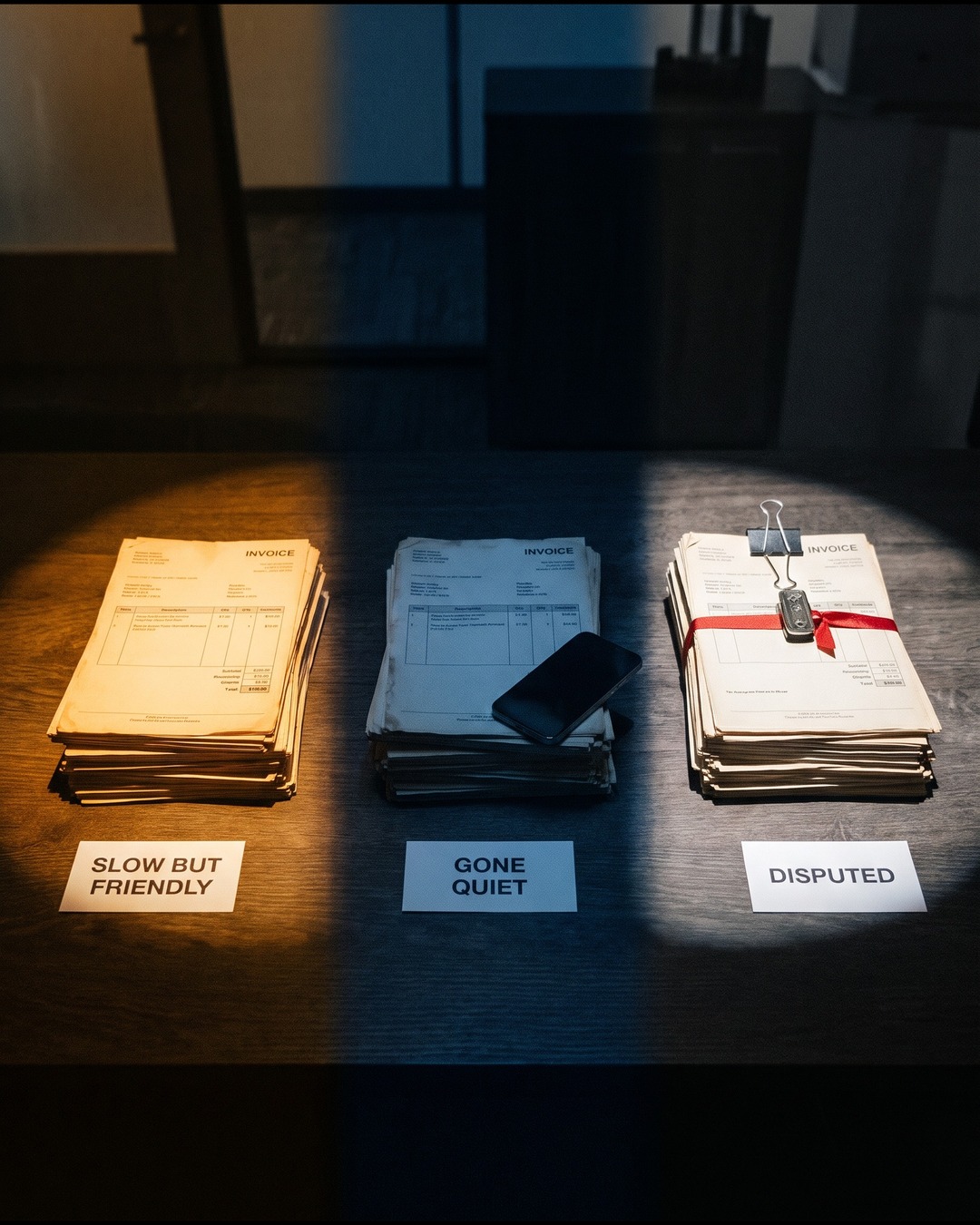
Chasing a disputed invoice as though it were simply late is how a small problem becomes a bigger one.
2. Check what your terms of trade say
Before you chase anything, look at your own terms. Do they say the customer pays interest on late accounts? Do they say the customer pays the reasonable costs of collecting what they owe? If your terms are silent, that changes what is realistic, and it is worth fixing for every invoice you send from now on.
We cannot tell you what the law allows in your situation, and we will not guess. Whether collection costs or interest can be added to what a customer owes depends on your terms, and the amount has to be reasonable. Your lawyer can confirm what your terms mean and whether they are fair, and a court can decide if it is ever challenged. It is far better to know before you start.
3. Have the basics ready
Whoever does the chasing, you will want these to hand for each invoice you are keeping:
A tidy record makes every next step quicker, and it protects you if the customer later says they were never told.
4. Decide who makes the call

Some owners are happy to ring a customer and ask for the money. Many are not. If it is the kind of call you keep putting off, that is the signal to hand it to someone else.
A licensed private investigation firm can act for you, on your written authority. It sends a clear written notice from a third party rather than another statement from you. It makes calls and sends emails in a factual, professional way, at reasonable hours. It keeps a dated record of every contact. And it reports back in writing, so you can see where each invoice stands.
5. Know where the line is
A good recovery firm will tell you what it will not do, and you should hold it to that.
- Contact customers lawfully, factually and politely.
- Keep a dated record of every contact.
- Report back to you in writing.
- Have debtors pay you directly.
- Hold your money. When a customer pays, they pay you directly.
- Give legal advice or start court action on its own. Anything that costs money or escalates should happen only on your written instruction.
- Argue a disputed debt for you. A genuine dispute comes straight back to you.
- Pressure or threaten anyone. If that is not how a firm talks to your customers, find another firm.
6. Where Debt Shield fits
Our service for this is called Debt Shield. You send us your overdue invoices. We run a disciplined chase on a set weekly rhythm of calls and emails, with written notices at set stages. Every action is logged, and you get a written report back on a regular schedule. Debtors pay you, not us. The decisions that matter stay with you.
It is not a fit for every invoice. A disputed account, for example, comes back to you. But for the ones that have simply gone quiet, a steady, lawful chase from a licensed private investigation firm is a reasonable next step.
Questions owners ask
Do you hold the money I am owed?
No. When a customer pays, they pay you directly.
What happens with a disputed invoice?
A genuine dispute comes straight back to you. It needs your records, and possibly a lawyer, before anyone chases it.
Is my enquiry confidential?
Yes. There is no obligation, and if it is not a job for us, we will say so.
Before you close for the year
You do not need to have it all in order before you pick up the phone. Call us and we will tell you plainly whether it is something we can help with. If it is not a job for us, we will say so.
Your enquiry is confidential, and there is no obligation. If you have a ledger that has stalled, call us on 021 0299 7590 or visit www.blacklistedinvestigations.co.nz. We are a licensed private investigation firm based in Taranaki and working across New Zealand.
Blacklisted Investigations. Licensed Private Investigators. MOJ Licence #22-099124.
This post is general information for business invoices, not legal advice. Blacklisted Investigations is a collection agent acting for the creditor who instructs us, not a lender. We do not issue court proceedings and do not provide legal services.
Follow Blacklisted Investigations: Facebook · Instagram · X
Got invoices that have gone quiet?
First consultation is free, confidential and obligation-free.